
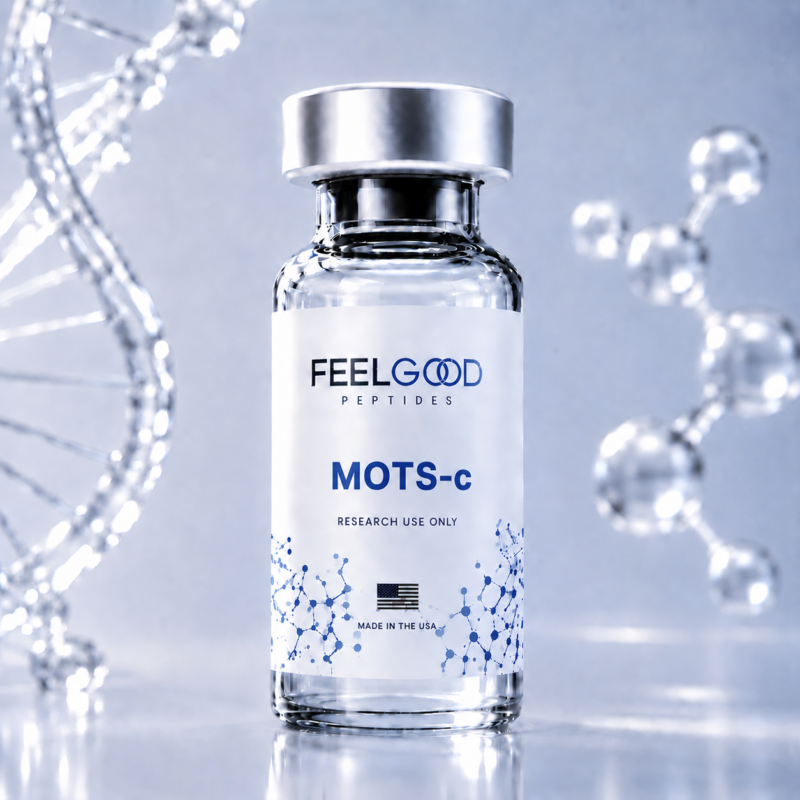
MOTS-c
MOTS-c
Longevity & Cellular Health
MOTS-c is a mitochondrial-derived peptide that plays a role in metabolic regulation. It is studied for its potential to improve energy utilization, insulin sensitivity, and physical performance.
- ✓ ≥99% purity
- ✓ Third-party COA
- ✓ US-synthesized
- ✓ Lyophilized powder

MOTS-c is studied to better understand mitochondrial signaling, metabolic regulation, and how mitochondria communicate with the rest of the cell under stress.
MOTS-c occupies a genuinely novel position in metabolic peptide research. Unlike most signaling peptides encoded in the nuclear genome, MOTS-c is transcribed from mitochondrial DNA — specifically from within the 12S rRNA gene sequence — placing it at the intersection of mitochondrial biology and systemic metabolic signaling in a way that has reshaped understanding of how mitochondria communicate with the rest of the cell and with distant tissues.
Its primary characterized mechanism involves AMPK pathway activation through endogenous AICAR accumulation in skeletal muscle cell preparations — a metabolic stress sensing pathway central to glucose uptake, fatty acid oxidation, and mitochondrial biogenesis research. What makes MOTS-c particularly interesting as a research tool is a second, unexpected mechanism: under oxidative stress conditions, MOTS-c undergoes nuclear translocation and directly engages antioxidant response element (ARE) transcriptional machinery alongside NRF2 — a behavior not previously associated with mitochondria-derived peptides and one that significantly expands its research utility into nuclear gene regulation and stress response pathway biology.
Together, these two mechanisms — cytoplasmic AMPK activation and stress-triggered nuclear ARE engagement — make MOTS-c a multi-compartment signaling tool compound relevant across metabolic, mitochondrial, and redox biology research disciplines.
- CAS Number: 1627580-64-6
- Molecular Weight: ~2174.64 g/mol
- Purity: ≥99%
- Also Known As: Mitochondrial Open Reading Frame of the Twelve S rRNA-c, MDP (Mitochondria-Derived Peptide), 12S rRNA-encoded peptide
- Chemical Formula: C₁₀₁H₁₅₂N₂₈O₂₂S₂
In cell-based and preclinical models, MOTS-c activates AMPK through an indirect but well-characterized metabolic mechanism. By inhibiting the de novo purine biosynthesis pathway in skeletal muscle cell preparations, MOTS-c drives intracellular accumulation of AICAR (5-aminoimidazole-4-carboxamide ribonucleotide) — an endogenous AMPK activator. This AICAR-mediated AMPK activation subsequently engages downstream glucose transporter translocation, fatty acid oxidation signaling, and mitochondrial biogenesis pathway activity in muscle cell preparations, consistent with AMPK’s established role as a central metabolic stress sensor.
A second mechanistic arm operates under conditions of metabolic stress. When skeletal muscle and human cell line preparations are exposed to glucose restriction or oxidative challenge (H₂O₂), MOTS-c undergoes nuclear translocation — confirmed by immunofluorescence and nuclear fractionation experiments across multiple human cell lines. Once in the nucleus, MOTS-c interacts with ARE transcriptional machinery and the NRF2 transcription factor, upregulating antioxidant and cytoprotective gene network expression in a stress-responsive pattern. This nuclear signaling behavior is mechanistically distinct from its cytoplasmic AMPK activity and represents an unexpected dual-compartment signaling profile for a mitochondria-derived peptide.
The combination of AMPK-mediated metabolic pathway regulation and NRF2/ARE-driven antioxidant gene expression makes MOTS-c a uniquely multi-layered tool compound for studying how mitochondrial-origin signals coordinate cytoplasmic and nuclear responses to metabolic and oxidative stress in cell-based research systems.
- AMPK Pathway Activation and AICAR Accumulation Studies
- Mitochondrial-Encoded Peptide Biology and MDP Signaling Research
- Skeletal Muscle Glucose Metabolism and Insulin Sensitivity Models
- NRF2/ARE Antioxidant Response Element and Nuclear Translocation Studies
- Oxidative Stress and Cytoprotective Gene Network Research
- De Novo Purine Biosynthesis Pathway Inhibition Studies
Related Products






Feedback From the Research Community
Questions before ordering?
Our Commitment to Quality
At Feel Good Peptides, quality, consistency, and transparency are at the core of everything we do. We work with qualified manufacturing partners and established ingredient suppliers to ensure that every product meets strict quality standards before being made available to our customers. The manufacturing process outlined in the certificate includes raw material verification, controlled production procedures, lyophilization (freeze-drying), batch traceability, and analytical testing designed to support product integrity and consistency.
Raw Material Verification
Every batch begins with carefully sourced active ingredients obtained from qualified manufacturers operating under established quality systems. Incoming materials undergo verification procedures prior to being approved for production. This process helps ensure that only materials meeting predefined specifications move forward into manufacturing.
Controlled Manufacturing Standards
Products are produced using documented procedures designed to maintain consistency and quality throughout the manufacturing process. Production includes precision formulation, sterile handling practices, environmental controls, and lyophilization (freeze-drying) to support stability and long-term storage. Batch records are maintained throughout production to provide accountability and traceability.
Quality Control & Testing
Quality verification is a critical part of every production run. Depending on the product, testing may include:
* Purity Analysis (HPLC)
* Identity Confirmation (Mass Spectrometry)
* Concentration Verification
* Endotoxin Testing
No batch is released without documented quality review procedures. Certificates of Analysis (COAs) are maintained to support transparency and batch verification.
Batch Traceability
Each product batch is assigned a unique lot number, allowing traceability from raw material receipt through finished product distribution. This system helps ensure accountability throughout the manufacturing and quality control process.
Research Use Only
All products offered by Feel Good Peptides are designated Research Use Only (RUO) and are intended solely for laboratory and scientific research applications. These products are not approved for human consumption, medical use, diagnosis, treatment, or prevention of any disease. Feel Good Peptides makes no therapeutic or medical claims regarding any product offered on this website.
Transparency You Can Trust
We believe customers should have confidence in the products they purchase. Through documented manufacturing procedures, batch traceability, and quality verification processes, Feel Good Peptides is committed to maintaining high standards of quality, consistency, and transparency across our product catalog.
Draw & Dose Calculator
Use the calculator below to calculate accurate peptide dosages.
Dose of Peptide
Peptide Strength
Bacteriostatic Water
Need more information?
Our team is ready to answer your questions.
Contact UsFor Research Use Only. Not for Human Consumption. Not a drug, supplement, or food product. All products are designated Research Use Only (RUO). Purchasers assume responsibility for ensuring compliance with all applicable regulations.
Reviews
There are no reviews yet.