
NAD+
NAD+
Longevity & Cellular Health
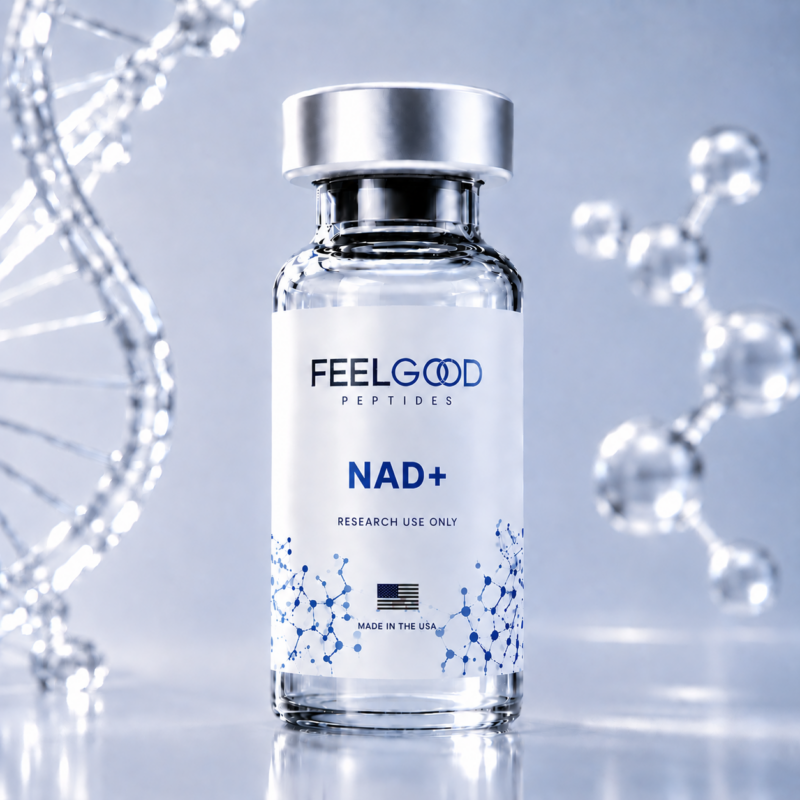
NAD+ is studied to better understand cellular energy metabolism, mitochondrial function, and the molecular pathways linked to anti-aging and DNA repair.
- ✓ ≥99% purity
- ✓ Third-party COA
- ✓ US-synthesized
- ✓ Lyophilized powder

NAD+ (Nicotinamide Adenine Dinucleotide) is a coenzyme essential for cellular energy production. It is commonly studied for its role in mitochondrial function, anti-aging research, and metabolic support.
NAD+ occupies a unique position in cellular biochemistry — it is simultaneously a redox carrier shuttling electrons through energy metabolism pathways and a signaling molecule whose intracellular concentration directly regulates the activity of NAD+-consuming enzymes including sirtuins, PARPs, and CD38. This dual role as both metabolic currency and enzymatic substrate makes it a research compound of unusual breadth, relevant across mitochondrial bioenergetics, epigenetic regulation, DNA damage response, and aging pathway research.
Research has characterized a progressive age-associated decline in intracellular NAD+ concentrations — approximately 50% between early and late adulthood in mammalian tissue models — with CD38 hydrolase upregulation in aged tissue preparations identified as a dominant driver of NAD+ consumption. This decline correlates with reduced sirtuin deacetylase activity, impaired mitochondrial function markers, and accumulating DNA damage signatures in cell-based aging models, positioning NAD+ availability as a regulatory nexus linking multiple aging-associated signaling pathways.
Kinetic characterization of SIRT1 has established that its deacetylase activity operates with a Km for NAD+ of approximately 170 μM under physiological conditions — meaning SIRT1 activity is sensitive to the physiological fluctuations in NAD+ concentration documented in aging cell preparations. This biochemical relationship between NAD+ availability and sirtuin activity is a primary focus of aging and longevity pathway research using NAD+ as a tool compound.
- CAS Number: 53-84-9
- Molecular Weight: 663.43 Da
- Purity: ≥99%
- Also Known As: NAD, Beta-NAD+, Nicotinamide Adenine Dinucleotide (oxidized form), Coenzyme I DPN (Diphosphopyridine Nucleotide, historical designation)
- Chemical Formula: C₂₁H₂₇N₇O₁₄P₂
In cell-based and biochemical models, NAD+ functions through two mechanistically distinct pathways. As a redox coenzyme, it accepts hydride equivalents during glycolysis, beta-oxidation, and the TCA cycle — cycling between its oxidized (NAD+) and reduced (NADH) forms to shuttle electrons to the mitochondrial electron transport chain, where their energy is captured through oxidative phosphorylation. This redox cycling activity is the central focus of mitochondrial bioenergetics and metabolic flux research using NAD+ as a substrate.
As an enzymatic co-substrate, NAD+ is cleaved at the nicotinamide-ribose bond by a family of NAD+-consuming enzymes. SIRT1 and other sirtuin deacetylases consume NAD+ during protein deacetylation reactions — releasing nicotinamide as a product inhibitor and O-acetyl-ADP-ribose as a byproduct. Structural characterization confirms NAD+ occupies a conserved Rossmann fold binding site during catalysis, and kinetic data establish that sirtuin activity is directly sensitive to intracellular NAD+ availability at physiologically relevant concentrations.
PARP enzymes consume NAD+ during ADP-ribosylation reactions at DNA damage sites — a DNA repair signaling pathway that competes with sirtuin activity for available NAD+ substrate in cell preparations under genotoxic stress conditions. CD38, a NAD+ hydrolase upregulated in aged tissue preparations, represents a third consumption pathway studied for its role in age-associated NAD+ depletion dynamics in cellular aging models.
- Sirtuin Activation and NAD+-Dependent Deacetylase Kinetics Studies
- Mitochondrial Bioenergetics and Oxidative Phosphorylation Research
- NAD+ Salvage and Biosynthesis Pathway Modeling
- PARP-Mediated DNA Repair and ADP-Ribosylation Studies
- CD38 Hydrolase Activity and Age-Associated NAD+ Depletion Research
- Cellular Aging and Redox Homeostasis Models
- Circadian Regulation and Metabolic Flux Studies
Related Products

Feedback From the Research Community
Questions before ordering?
Our Commitment to Quality
At Feel Good Peptides, quality, consistency, and transparency are at the core of everything we do. We work with qualified manufacturing partners and established ingredient suppliers to ensure that every product meets strict quality standards before being made available to our customers. The manufacturing process outlined in the certificate includes raw material verification, controlled production procedures, lyophilization (freeze-drying), batch traceability, and analytical testing designed to support product integrity and consistency.
Raw Material Verification
Every batch begins with carefully sourced active ingredients obtained from qualified manufacturers operating under established quality systems. Incoming materials undergo verification procedures prior to being approved for production. This process helps ensure that only materials meeting predefined specifications move forward into manufacturing.
Controlled Manufacturing Standards
Products are produced using documented procedures designed to maintain consistency and quality throughout the manufacturing process. Production includes precision formulation, sterile handling practices, environmental controls, and lyophilization (freeze-drying) to support stability and long-term storage. Batch records are maintained throughout production to provide accountability and traceability.
Quality Control & Testing
Quality verification is a critical part of every production run. Depending on the product, testing may include:
* Purity Analysis (HPLC)
* Identity Confirmation (Mass Spectrometry)
* Concentration Verification
* Endotoxin Testing
No batch is released without documented quality review procedures. Certificates of Analysis (COAs) are maintained to support transparency and batch verification.
Batch Traceability
Each product batch is assigned a unique lot number, allowing traceability from raw material receipt through finished product distribution. This system helps ensure accountability throughout the manufacturing and quality control process.
Research Use Only
All products offered by Feel Good Peptides are designated Research Use Only (RUO) and are intended solely for laboratory and scientific research applications. These products are not approved for human consumption, medical use, diagnosis, treatment, or prevention of any disease. Feel Good Peptides makes no therapeutic or medical claims regarding any product offered on this website.
Transparency You Can Trust
We believe customers should have confidence in the products they purchase. Through documented manufacturing procedures, batch traceability, and quality verification processes, Feel Good Peptides is committed to maintaining high standards of quality, consistency, and transparency across our product catalog.
Draw & Dose Calculator
Use the calculator below to calculate accurate peptide dosages.
Dose of Peptide
Peptide Strength
Bacteriostatic Water
Need more information?
Our team is ready to answer your questions.
Contact UsFor Research Use Only. Not for Human Consumption. Not a drug, supplement, or food product. All products are designated Research Use Only (RUO). Purchasers assume responsibility for ensuring compliance with all applicable regulations.
Reviews
There are no reviews yet.