
Tesamorelin
Tesamorelin
Muscle Growth & Recovery
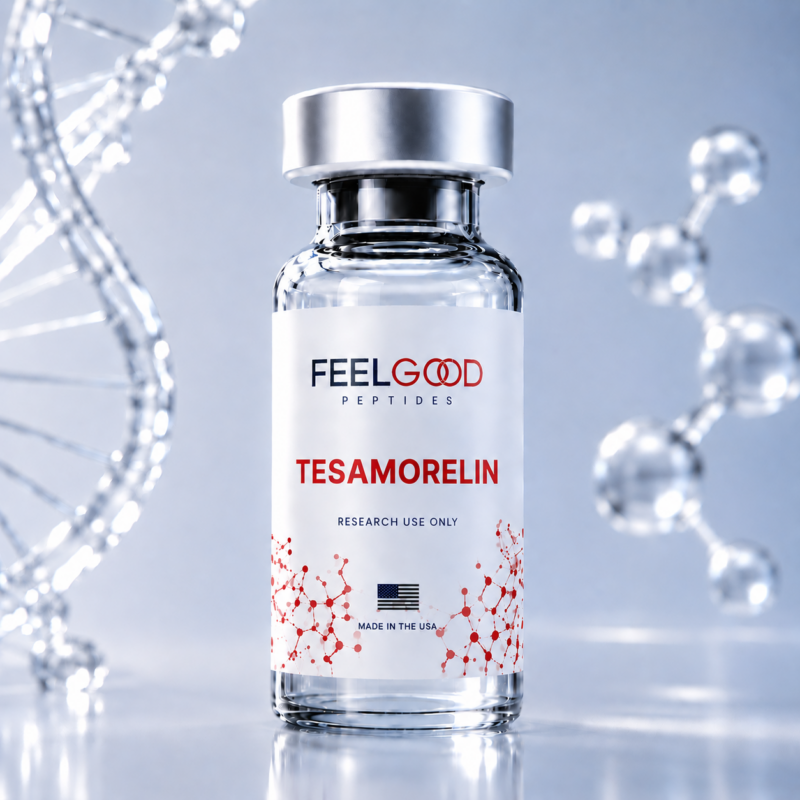
Tesamorelin is a growth hormone-releasing peptide that stimulates endogenous GH production. It is often researched for fat metabolism, particularly visceral fat reduction, and metabolic support.
- ✓ ≥99% purity
- ✓ Third-party COA
- ✓ US-synthesized
- ✓ Lyophilized powder

Tesamorelin is studied to better understand growth hormone signaling, visceral fat metabolism, and the hormonal pathways linking GH release to metabolic health.
Tesamorelin belongs to the GHRH analog peptide class and is distinguished from shorter GHRH-derived fragments — such as CJC-1295 (No DAC) — by its full 44-amino acid sequence, which preserves the complete receptor contact surface of native GHRH. Its N-terminal trans-3-hexenoic acid modification confers resistance to dipeptidyl peptidase IV (DPP-IV) enzymatic cleavage, extending its active half-life in biological preparations without altering its receptor binding profile.
Research interest in Tesamorelin centers on its activity in the GH/IGF-1 axis and the downstream metabolic signaling consequences of sustained GHRHR activation — particularly in visceral adipose tissue biology models. In preclinical metabolic preparations, GH axis stimulation via GHRHR engagement has been associated with lipolytic signaling in visceral fat depots, IGF-1 upregulation, and insulin sensitivity pathway modulation — mechanistic areas that make Tesamorelin relevant across GH axis, adipose tissue, and metabolic signaling research.
Its well-defined receptor target, full-length sequence, and documented stability profile make it a precise and reproducible tool compound for researchers studying GHRHR pharmacology and GH-dependent metabolic pathway activity in controlled laboratory settings.
- CAS Number: 901758-09-6
- Molecular Weight: ~5196 g/mol
- Purity: ≥99%
- Also Known As: TH9507, Egrifta (pharmaceutical formulation — not supplied here), Trans-3-hexenoic acid-GHRH(1-44), GHRH analog (full-length)
- Chemical Formula: C₂₂₃H₃₇₀N₇₂O₆₉S
In cell-based and preclinical models, Tesamorelin binds to GHRHR on pituitary somatotroph preparations, activating Gs-coupled adenylyl cyclase signaling and intracellular cAMP accumulation. Downstream PKA activation drives GH granule exocytosis and somatotroph gene transcription in a pattern consistent with physiological GHRH receptor stimulation. Its N-terminal modification confers DPP-IV resistance, preserving receptor occupancy and extending the cAMP signaling window relative to unmodified GHRH in biological assay systems.
Elevated GH output in preclinical preparations subsequently stimulates hepatic IGF-1 production through GH receptor-mediated JAK2/STAT5 signaling — a well-characterized axis in GH pharmacology research. Downstream IGF-1 receptor activation engages PI3K/Akt and MAPK/ERK cascades in target tissue preparations, contributing to the anabolic and metabolic signaling consequences studied in GH axis research models.
In visceral adipose tissue preparations, GH axis activation via Tesamorelin has been associated with hormone-sensitive lipase stimulation and lipolytic signaling — mechanistically consistent with the selective visceral fat depot activity characterized in preclinical metabolic models. This adipose-selective lipolytic profile, combined with upstream GHRHR specificity, makes Tesamorelin a useful tool for dissecting GH-dependent fat metabolism signaling from broader adrenal or gonadal axis activity in metabolic research designs.
- GHRHR Binding and Receptor Pharmacology
- GH Axis Signaling and Somatotroph Biology
- IGF-1 Pathway and JAK2/STAT5 Signaling Studies
- Visceral Adipose Tissue Lipolysis Modeling
- DPP-IV Resistance and Peptide Stability Research
- Metabolic Pathway and Insulin Sensitivity Studies
- GHRH Analog Comparative Pharmacology
Related Products


Feedback From the Research Community
Questions before ordering?
Our Commitment to Quality
At Feel Good Peptides, quality, consistency, and transparency are at the core of everything we do. We work with qualified manufacturing partners and established ingredient suppliers to ensure that every product meets strict quality standards before being made available to our customers. The manufacturing process outlined in the certificate includes raw material verification, controlled production procedures, lyophilization (freeze-drying), batch traceability, and analytical testing designed to support product integrity and consistency.
Raw Material Verification
Every batch begins with carefully sourced active ingredients obtained from qualified manufacturers operating under established quality systems. Incoming materials undergo verification procedures prior to being approved for production. This process helps ensure that only materials meeting predefined specifications move forward into manufacturing.
Controlled Manufacturing Standards
Products are produced using documented procedures designed to maintain consistency and quality throughout the manufacturing process. Production includes precision formulation, sterile handling practices, environmental controls, and lyophilization (freeze-drying) to support stability and long-term storage. Batch records are maintained throughout production to provide accountability and traceability.
Quality Control & Testing
Quality verification is a critical part of every production run. Depending on the product, testing may include:
* Purity Analysis (HPLC)
* Identity Confirmation (Mass Spectrometry)
* Concentration Verification
* Endotoxin Testing
No batch is released without documented quality review procedures. Certificates of Analysis (COAs) are maintained to support transparency and batch verification.
Batch Traceability
Each product batch is assigned a unique lot number, allowing traceability from raw material receipt through finished product distribution. This system helps ensure accountability throughout the manufacturing and quality control process.
Research Use Only
All products offered by Feel Good Peptides are designated Research Use Only (RUO) and are intended solely for laboratory and scientific research applications. These products are not approved for human consumption, medical use, diagnosis, treatment, or prevention of any disease. Feel Good Peptides makes no therapeutic or medical claims regarding any product offered on this website.
Transparency You Can Trust
We believe customers should have confidence in the products they purchase. Through documented manufacturing procedures, batch traceability, and quality verification processes, Feel Good Peptides is committed to maintaining high standards of quality, consistency, and transparency across our product catalog.
Draw & Dose Calculator
Use the calculator below to calculate accurate peptide dosages.
Dose of Peptide
Peptide Strength
Bacteriostatic Water
Need more information?
Our team is ready to answer your questions.
Contact UsFor Research Use Only. Not for Human Consumption. Not a drug, supplement, or food product. All products are designated Research Use Only (RUO). Purchasers assume responsibility for ensuring compliance with all applicable regulations.
Reviews
There are no reviews yet.